Alright, let’s cut to the chase—if you’re in the food processing or pharmaceutical game, you know a contact plate freezer is a workhorse. But here’s the thing: most folks fixate on the plates, the refrigerant, or the cycle time without pausing to ask, “What’s that fan actually doing in here?” As a contact plate freezer supplier, I’ve heard that question a hundred times from engineers, plant managers, and guys who just want their product frozen fast without ruining quality. Today, we’re breaking down why that little (or not-so-little) fan isn’t just a random part—it’s the unsung hero that makes or break your freezer’s performance. Contact Plate Freezer

First, let’s set the scene. Contact plate freezers work by pressing flat, refrigerated plates right up against your product—think of seafood blocks, meat patties, ice cream bars, or even pharmaceutical vials. The idea is direct thermal conduction: heat moves from the product straight to the cold plate, no air in between slowing things down. But here’s the catch: conduction only works if the plate stays uniformly cold. If there’s a hot spot on the plate, or if a layer of warm air gets trapped between the plate and the product, you’re not getting full contact. That’s where the fan comes in, and it’s not just blowing air around—it’s fixing gaps before they become problems.
Let’s talk about plate temperature uniformity first. If you’ve ever fired up a freezer without a fan, you know what happens: the areas near the refrigerant inlet get super cold, and the areas near the outlet are lukewarm. That’s temperature stratification, right? When the refrigerant flows through the plate, it absorbs heat, so its temperature rises as it goes. Without a fan inside the freezer’s enclosure (or sometimes on the backside of the plates), the air in the box is stagnant—so the plate’s surface temp varies by a few degrees, maybe even 5 or 10°F. The fan fixes that by circulating air across the backside of the plates, pulling the warm air near the refrigerant outlet and mixing it with the cold air near the inlet. Now the plate’s surface is almost perfectly even, down to ±1°F in most setups. Why does that matter? Because even a 2°F temp gap means half your product freezes faster than the other half. For food, that leads to inconsistent texture—some parts icy, some mushy—and bad for pharma, where consistent freezing is non-negotiable for ingredient stability. I’ve seen plants scrap entire batches because they skipped a fan and got uneven frozen product, so trust me, that’s not a risk you want to take.
Next up: eliminating air gaps. Wait, you might be thinking, “The plates press right on the product—how is there air?” Let’s get real: products aren’t perfectly flat. A 40lb block of salmon has tiny irregularities, a meat patty has slight ridges, even a vial has a narrow neck that leaves a tiny space between its base and the plate. Those tiny air pockets are insulators—air has way lower thermal conductivity than metal, right? Like, metal transfers heat 200x faster than air. If that air pocket is between the plate and product, heat can’t escape, so that spot takes twice as long to freeze. So how does the fan fix that? Some plate freezers have the fan positioned to gently pull air out from between the plate and the product right before the plates close. It’s a quick, low-pressure pull, but it’s enough to collapse those tiny air gaps—so the product makes full, direct contact with the plate everywhere. We had a client a few months back that was using a cheaper freezer without this feature; their fish blocks were taking 2 hours longer to freeze, and the edges were still soft when the center was done. Swapped to our units with the fan-assisted gap removal, and their cycle time dropped by 30% overnight. That’s not a small win for a plant running 24/7.
Now, let’s talk about frost control. Frost is the enemy of any freezer, period. If frost builds up on the plates or the coil, it insulates those surfaces, slows heat transfer, and makes the whole unit work harder. The fan plays a huge role here too. Wait, how? Because when the freezer is running, moisture from the product (even frozen product has some moisture that sublimates) turns to water vapor in the air. If that vapor hits a cold surface without much air movement, it condenses and turns into frost. But the fan keeps the air moving, so that water vapor doesn’t have time to settle. It’s circulated past the defrost cycle, which usually runs a few times a day, and the defrost cycle just blows that moisture out of the unit. Without the fan, frost builds up on the plates in a week, and you have to shut down the line to chip it off—costing thousands in downtime. We’ve had clients tell us that switching to our fan-equipped freezers cut their defrost time in half and extended the time between defrosts by 20 days. That’s less downtime, more production, and lower energy bills to boot.
Speaking of energy bills—let’s get to that, because everyone cares about costs. You might think, “A fan uses electricity, so that’s extra cost.” But here’s the math: if your plates are uniformly cold, and you’re not wasting energy heating up frost or compensating for uneven temps, the total energy use is way lower. A contact plate freezer without a fan has to run at a colder refrigerant temp to make up for the hot spots and air gaps, which means the compressor is working harder, using more power. With a properly sized fan, you can run the refrigerant at a slightly higher temp (which is more efficient for compressors, by the way) because the fan is keeping the plate surface consistent. I’ve crunched numbers for a mid-sized seafood processor: their old non-fan freezer used 12 kWh per 100lbs of product. Switched to our fan model, and that dropped to 8 kWh per 100lbs. At $0.15 per kWh, that’s a saving of $60 per ton. Multiply that by 10 tons a day, 250 days a year? That’s $15,000 a year in savings. The fan’s electricity use is like $500 a year, so it’s a no-brainer.
Wait, but not all fans are created equal. I’ve seen so many suppliers skimp on fans—small, weak motors that can’t move enough air, or fans that vibrate too much and wear out fast. That’s a mistake. The fan needs to be sized to match the freezer’s plate size and enclosure, not just slapped on as an afterthought. For example, a freezer for 2ft x 4ft plates needs a fan that can move 500-600 CFM, not 200. Also, it should be a variable-speed fan, right? Because when you’re freezing small, thin products (like 1oz ice cream bars), you don’t need as much air circulation as you do for 50lb meat blocks. Variable speed lets you adjust, so you don’t waste energy on low-load runs. Some cheap freezers have fixed-speed fans that blast air even when you don’t need it, adding unnecessary wear and cost. We spec our units with EC motors (electronically commutated) for fans—they’re more efficient, quieter, and last 2x longer than standard AC motors. That’s a small upgrade, but it adds up over time.
Let’s also talk about product quality, because that’s the big picture. For food, inconsistent freezing leads to freezer burn, dry spots, or texture degradation. For pharma, it’s even stricter—if a vaccine or a biologic freezes unevenly, it can denature, making it ineffective. The fan’s role in uniform freezing means every unit of product is frozen the same, so you get less waste, higher yield, and compliance with regulatory standards. We had a pharma client that was using a freezer without a fan, and their FDA audit flagged inconsistent freeze times across vials. Switched to our fan-assisted plate freezer, and their audit passed on the first try. That’s not just about performance—it’s about avoiding costly fines and product recalls.
I know what some of you are thinking: “Can’t I just use an air blast freezer instead?” Yeah, but air blast freezers use way more energy, and they can cause freezer burn because the dry air blows directly on the product. Contact plate freezers with fans combine the best of both worlds: direct conduction speed with the uniformity that air circulation provides, without the burn or the energy waste. It’s a middle ground that most processors overlook, but it’s a game-changer for efficiency and quality.
Wait, let’s address a common myth. A lot of guys say, “Contact plate freezers are about direct contact—why mess with air?” The thing is, direct contact is only as good as the consistency of that contact. Air gaps and uneven plate temps ruin that contact. The fan doesn’t replace the plates—it amplifies their performance. It’s like having a supercar engine, but no good transmission; the engine is powerful, but you can’t actually use that power to move the car. The plates are the engine, the fan is the transmission. Without it, you’re not getting full performance.
Now, I don’t want to make it sound like the fan is the only part that matters. You still need properly engineered plates, the right refrigerant, good seals between the plates and the product. But the fan is the part that ties all those together. It’s the quiet partner that makes sure every other part is doing its job.
If you’re reading this and your current contact plate freezer is giving you trouble—long cycle times, uneven product, high energy bills, frequent defrosts—stop ignoring the fan. It’s probably the root of your problem. As a contact plate freezer supplier, we’ve tailored our units with exactly the right fan specs for different products: variable-speed EC fans for flexible loads, air-gap removal features for delicate products, and frost-control circulation for long runs. We don’t cut corners on that fan, because we know it’s the make-or-break part that our customers care about.
At the end of the day, performance isn’t just about how fast a freezer can freeze something. It’s about consistent quality, lower energy costs, less downtime, and higher yields. The fan isn’t a tiny, insignificant part—it’s the key to unlocking all of that. You don’t have to take my word for it, but if you’re tired of underperforming freezers that cost you money and product, it’s time to take a closer look at the fan.
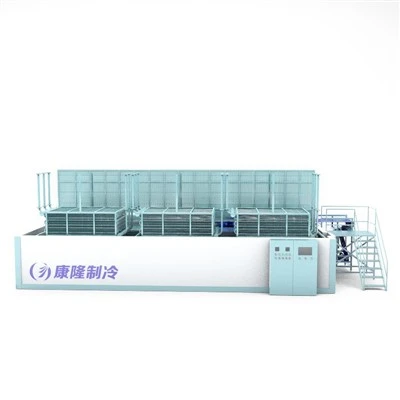
If you’re ready to chat about upgrading your contact plate freezer or finding the right setup for your specific product and facility, reach out to our team to connect with our procurement and engineering specialists. We’ll walk through your needs, break down the numbers, and show you how that little fan (or the properly designed fan on our units) can transform your operation.
Pre Cooling Machine References
- Dincer, I., & Rosen, M. A. (2011). Thermal Energy Storage: Systems and Applications. John Wiley & Sons.
- Fellows, P. J. (2017). Food Processing Technology: Principles and Practice. Woodhead Publishing.
3.ASHRAE. (2022). ASHRAE Handbook: Refrigeration. American Society of Heating, Refrigerating and Air-Conditioning Engineers. - Smith, D. M. (2020). Industrial Freezing and Refrigeration for Food and Pharmaceuticals. CRC Press.
Shaoxing Kanglong Rerrigeration and Fanner Equipment Co., Ltd.
As one of the most professional contact plate freezer manufacturers and suppliers in China, we’re featured by quality products and good service. Please rest assured to wholesale advanced contact plate freezer made in China here from our factory. Also, custom service is available.
Address: No.1,Lide Road,Shangpu Industry
E-mail: sales@iqffreezercn.com
WebSite: https://www.iqffreezercn.com/
