Hey everyone, thanks for popping into my little corner of the industrial blog. I run a company that supplies bore welders—y’know, the gear that keeps big boring machines running smoothly, like those used in construction, mining, oil and gas, even heavy manufacturing for huge parts. I get this question literally every single day: “What’s the maximum diameter a bore welder can actually weld?” It’s not a one-word answer, and I’ve seen way too many people give vague, generic numbers that don’t apply to their specific job, so let’s break this down like we’re chatting over a coffee (no stuffy textbook jargon, promise). Bore Welder

First off, let’s get one thing straight: there is no universal max diameter for a bore welder. It depends on way more than just the machine itself—like the type of weld you need, the access you’ve got to the bore, even the material you’re working with. Let’s start with the basics of how bore welders work, just to set the stage. A bore welder (also called an in-line welder or orbital bore welder, though orbital is a specific type) is set up inside a cylindrical hole—say, a big bearing bore in a mining shovel’s arm, or a pipe bore in an oil rig’s riser, or a cylinder bore in a heavy-duty hydraulic press. The welding head spins around the center point of the hole, layering weld material to fix wear, corrosion, or cracks. So the “diameter” we’re talking about is the inner diameter (ID) of the bore, right? That’s the gap the welder has to fit inside, not the outer size of the part.
Now, let’s talk about the real numbers I see every week from customers. For super small bores—like a 1-inch ID in a small hydraulic cylinder—we’ve got compact manual bore welders that fit in there no problem. Their max diameter tops out around 6 inches, easy. Those are great for light repairs, not big heavy-duty work. Then we move into the mid-range stuff, which is what most of our customers use for general construction and mining. Those orbital bore welders (the automated kind that spins the weld head evenly) can handle bores from like 6 inches all the way up to 48 inches. Wait, 48 inches is 4 feet— that’s huge, right? I helped a customer last year fix a 42-inch bore in a giant earthmover’s swing bearing, and we used one of our mid-range orbital units, no issues. But hold on— that’s not the end. We’ve got heavy-duty industrial grade bore welders that are built for the big boys. Those are the ones for power plant turbines, massive pipeline crossings, or offshore rig components. Those can go way past 48 inches. We’ve sold units that handle up to 120-inch ID bores before. 10 feet across! That’s like welding the inside of a small basement pipe. But here’s the catch— you can’t just grab a 120-inch bore welder for a 24-inch job, it’s overkill, bulky, and a pain to transport.
Wait, so why can’t a mid-range unit go to 60 inches? It’s not about the welder itself all the time. The biggest limit is the weld head setup and the access around the bore. If you’ve got a bore that’s 50 inches across, but the part it’s in only has a 40-inch opening to get the welder into the bore, you can’t fit a 50-inch weld head through that opening. That’s a huge one people forget. I had a customer a few months back working on a big gearbox with a 55-inch ID bore, but the only access port was 42 inches. He tried to get a standard orbital welder, but the weld head was too big to fit through the port. We ended up modifying one of our modular bore welders— we took apart the weld head’s outer ring so we could slide it through the port, then reassemble it inside the bore. Now that’s the kind of real-world problem solving you can’t get from a spec sheet, y’know?
Next factor: weld type. If you’re doing a simple single-pass weld to patch a small corroded spot in a 30-inch bore, that’s way easier than building up a multi-layer weld to fix a crack in a 60-inch load-bearing bore. Multi-layer welds need the head to sit closer to the wall of the bore, so you might need a slightly larger head to accommodate the wire feed and heat dissipation. Also, if you’re welding thick material (like steel plates 2 inches thick for a mining application), you might need a machine with higher amperage, which means a slightly larger power unit that can’t squeeze into a tiny bore. We had a customer try to use a 100-amp bore welder on a 10-inch bore a while back— it fit, but the power supply was too big to mount inside the bore, so he had to run a cord all the way out, which created friction and messed up the weld. We swapped him to a smaller 50-amp compact unit that fit inside, and his weld quality went up 100%.
Material matters too, believe it or not. If you’re welding mild steel, the max diameter is almost always limited by access, not the machine. But if you’re working with high-alloy steel, stainless steel, or even exotic metals like Inconel used in power plants, you need more precise heat control, so the weld head can’t be as compact. Those precision bore welders might have a max diameter a foot smaller than a general-purpose unit that works on plain steel. I worked with a nuclear power plant customer last year needing to weld a 36-inch bore made of stainless steel— we had to use our precision orbital unit, which had a max diameter of 38 inches, perfect for his job. If he’d used our general unit that goes up to 48 inches, he would’ve had too much heat fluctuation and ruined the alloy, which would’ve been a $100k mistake.
Also, don’t sleep on mobile vs. fixed bore welders. Fixed units are for when the part never moves— like a big pipe that’s installed and you can’t move it. Those can handle even bigger diameters, up to 150 inches sometimes, because they’re mounted to a rail that runs all the way around the outside of the bore, so the weld head is self-supporting. But mobile bore welders (the ones we sell most of) are built to ship to job sites, fit in a truck, and be set up in a few hours. Those max out around 120 inches, as I mentioned, because anything bigger is too bulky to haul around.
Wait, let’s clear up a common myth: some people think bigger is always better. No way. A customer last year wanted to repair a 18-inch bore, and he asked for the biggest welder we had, thinking it would be faster. But the big unit was heavier, cost twice as much, and took 3 hours to set up, compared to our compact 18-inch unit that took 20 minutes. He ended up swapping, saved money, and the job got done faster. The spec sheet might list a max diameter, but you need to match the machine to your actual job, not the other way around.
So putting it all together, here’s the real, no-BS breakdown I give every customer when they ask about max diameter:
- For small, light jobs, general repair: 2–6 inches max.
- Most common mid-range jobs (construction, general mining): 6–48 inches max.
- Heavy-duty industrial, large parts: 48–120 inches max.
- Custom, specialized jobs can go beyond 120 inches, but that’s rare, and requires modifying or building a unit specific to your access and needs.
And if you’re still not sure how big your weld needs to be, or what machine fits your bore, that’s what we’re here for. I’ve been supplying bore welders for 12 years, and I’ve seen every possible scenario— from 1-inch hydraulic cylinders to 10-foot turbine bores. I don’t just sell you a machine off the shelf; I’ll work with you to figure out exactly what you need, no hidden fees, no confusing fine print. Whether you’re a small construction team doing equipment repairs or a big mining company needing to fix a massive excavator, we’ve got the gear and the know-how to get the job done right.
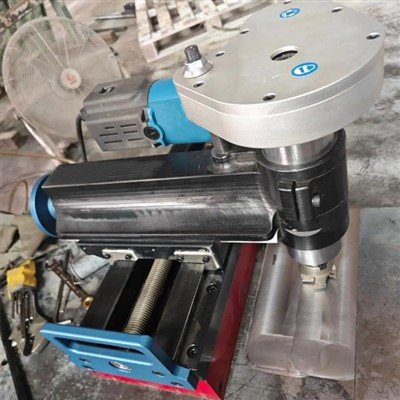
If you’ve got a bore welder question, need a quote, or just want to chat through your next job, don’t hesitate to reach out. I’m always here to help, no matter how big or small your project is.
Line Boring Accessories References:
- American Welding Society. (2021). "Orbital Welding for Cylindrical Components". AWS Welding Handbook, Volume 4: Structural Welding.
- Industrial Machinery Association. (2022). "Bore Welder Specifications and Application Guidelines". Industrial Equipment Journal.
- Global Construction Equipment Association. (2023). "Field Repair Technologies for Heavy Machinery Bores". Construction Industry Report.
Shangqiu JDA Machinery Technology Co., Ltd.
With abundant experience, we are one of the most professional bore welder manufacturers and suppliers in China. We warmly welcome you to buy cheap bore welder for sale here from our factory. Quality products and reasonable price are available.
Address: No. 55 Pingyuan Middle Road, Liangyuan District, Shangqiu, Henan, China
E-mail: sales@jdamachines.com
WebSite: https://www.jdamachines.com/
