If you’ve ever worked in the nuclear power space, you know that reactor vessel embrittlement is one of those quiet, slow-creeping risks that can tank a unit’s lifespan if you don’t catch it early. As a reactor vessel supplier, I get asked all the time: “Wait, how do you even test this stuff? It’s not like you can yank the whole vessel out every five years to run a diagnostic.” It’s a fair question—vessels stay in place for 40, 60, even 80 years, so every test we do has to be non-invasive, accurate, and tailored to the way radiation and neutrons actually mess with your steel over time. Reactor Vessel
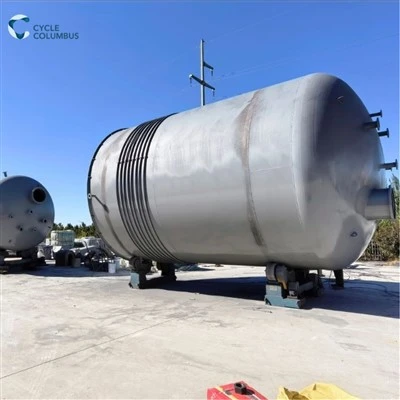
Let me break this down like I would to a fellow engineer who’s knee-deep in plant operations, not a textbook. First, let’s get one thing straight: embrittlement isn’t some random flaw. It happens when fast neutrons (the high-energy ones that come from fission in the core) slam into the reactor vessel’s steel, knocking atoms out of place and creating tiny, brittle clusters of defects. Over decades, those clusters build up, making the steel less able to flex when pressure or temperature spikes—think of a copper wire that gets folded too many times, it snaps instead of bending. The goal of every test we run is to measure that damage without disrupting the plant’s power production, because a planned outage is way better than an unplanned shutdown.
The big one everyone talks about is surveillance sampling, and it’s the OG method for a reason. Back when a new reactor is built, we build six or seven small, identical steel “test coupons” right into the vessel’s inner wall, in spots that get hit with roughly the same neutron radiation as the main vessel. These coupons are sealed in small, metal capsules that poke out through the vessel’s head (so they’re easy to get to during outages) and stay in the exact same radiation zone as the vessel for the plant’s entire design life. Every few years, when the plant schedules a mid-cycle or major refueling outage, we pull one coupon out, run a bunch of tests on it, and extrapolate what’s happening to the main vessel.
Wait, you might be wondering: why extrapolate? Why not just test the actual vessel steel? Because yanking a sample from the main vessel would require welding a hole in the wall, which compromises its integrity—we can’t do that. The coupons are a perfect stand-in. When we pull a coupon, first we do a Charpy impact test, which is the most common way to measure embrittlement. Basically, you hit the coupon with a weighted pendulum, first at room temp, then at lower and lower temps, and measure how much energy it absorbs when it breaks. A ductile steel bends a lot and absorbs a ton of energy; a brittle steel snaps clean and absorbs way less. We track the “reference transition temperature (RTT_NDT)” — that’s the temp where the steel shifts from bending to snapping. Over time, as neutron damage builds, that temperature creeps up. If it gets too high, the steel is brittle even at normal operating temps. For example, a brand-new vessel might have an RTT_NDT of -60°F; after 30 years of operation, that could jump to 0°F, which is a big red flag.
We also do a tensile test on surveillance coupons, where we pull the coupon apart until it breaks, to measure yield strength and ductility. Embrittled steel has way less ductility—its elongation at break drops from like 20% to under 5%, and its tensile strength goes up. These numbers feed into our embrittlement models, which we use to predict how the vessel will behave for 10, 20, 30 more years. The nice part about surveillance coupons is they give us hard, empirical data to tweak those models—no guesswork here.
But surveillance sampling only works for reactors that have these coupons built in. What if a plant has an older reactor, built before standard surveillance programs were mandatory? Or what if we need a more real-time check, not just data every 5 years? That’s where in-service non-destructive examination (NDE) comes in, and this is the area our team has been tweaking a lot lately. The old NDE method for embrittlement was ultrasonic testing (UT), but traditional UT only measures big flaws, like cracks or corrosion— it can’t pick up the tiny atomic clusters that cause embrittlement. Newer ultrasonic methods, like low-frequency ultrasonic attenuation and velocity testing, are game changers here. We send sound waves through the vessel wall, and the way the waves slow down or lose energy tells us how many tiny defects are inside the steel. We can also use electromagnetic testing, like eddy current testing, which measures changes in the steel’s electrical conductivity—embrittled steel has a slightly different conductivity than undamaged steel, so that gives us another data point to cross-reference.
Wait, there’s also a trick called “reactor pressure vessel wall thinning and embrittlement assessment via neutron diffraction,” but that’s for more advanced diagnostics. We can measure the strain in the steel crystal structure with neutron beams from a research reactor, which lets us see how the atomic lattice has warped from neutron damage. That’s super accurate, but it’s more of a research tool right now, not something you do every outage— it’s more for validating our models, not routine testing.
Let me be honest here: every test has its limits. Surveillance coupons are great, but they’re not exactly in the same spot as the main vessel. If the core shifts a little over time, the neutron flux at the coupon might be slightly different than the main wall, so we have to adjust our extrapolations. NDE methods are non-invasive, but they’re sensitive to things like welds, corrosion, and temperature changes during testing—you can’t just run a UT scan at 100°F if the vessel is at 60°F, because the temp will throw off the readings. That’s why we always use a combination of tests: surveillance data to ground our models, NDE to check for unexpected damage, and models to fill in the gaps between outages.
As a reactor vessel supplier, our whole job is to make sure your vessel is safe for its entire life, which means we don’t just build the vessel and walk away. We work closely with plant operators to set up their surveillance program, help them analyze their test data, and adjust as needed. If you’re working on a license renewal project, or you just want to run a check on your vessel to make sure you’re not missing any hidden embrittlement, we can walk through the testing process with you—from selecting the right surveillance coupon locations if you’re building a new vessel, to running NDE scans on an existing unit, to interpreting the data to predict your vessel’s remaining lifespan.
At the end of the day, reactor vessel embrittlement testing isn’t rocket science, but it’s precise. It’s about balancing non-invasive methods to avoid plant downtime, accurate sampling to get real data, and modeling to make sure you can plan for the future. If you’re ready to talk about testing your reactor vessel, or you’re looking for a new vessel built with the latest surveillance and testing protocols, reach out. We’re here to make sure your plant runs safely, reliably, and for as long as you need it.
Wastewater Treatment System References:
- International Atomic Energy Agency. (2018). Reactor Vessel Embrittlement Surveillance and Evaluation. IAEA Nuclear Energy Series No. NP-T-3.15.
- American Society of Mechanical Engineers. (2022). Boiler and Pressure Vessel Code, Section III, Division 1, Subsection NB.
- Nuclear Regulatory Commission. (2021). Regulatory Guide 1.99, Revision 3: Radiation Embrittlement of Reactor Vessel Materials.
Beijing Cycle Columbus Environmental Science & Technology Co., Ltd.
Beijing Cycle Columbus Environmental Science & Technology Co., Ltd. is one of the most professional reactor vessel manufacturers and suppliers in China. We are committed to providing high quality customized products with competitive price. Please feel free to buy advanced reactor vessel made in China here from our factory. Also, quotation is available.
Address: 1201, 12/F, Tower B, Bldg 8, Guancheng Garden, Haidian District, Beijing, China
E-mail: Info@saikekanglun.com
WebSite: https://www.cycle-columbus.com/
