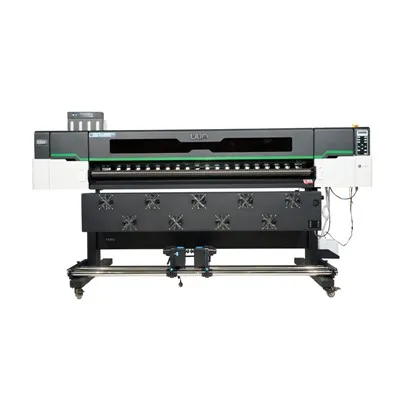
If you’ve ever stepped into a trade show, a large-format print shop, or even a local event space, you’ve probably seen the work of eco solvent printers—from vibrant storefront banners that stand up to rain to murals that line public transit hubs. As someone who’s spent the last 12 years supplying eco solvent printers to print shops, small business owners, and even custom sign makers across North America, I get asked one question more than any other: “What’s the maximum print length I can get from these machines?” Eco Solvent Printer
It’s a fair question. Too long, and you’re left with seams that ruin the crisp, seamless look clients demand. Too short, and you’ll have to piece together a project that could have been one single, perfect roll—wasting time, materials, and money in the process. Let’s cut through the marketing fluff, get into the science of how these printers work, and break down what “maximum print length” actually means for real-world projects. No jargon, no overpromises, just the straight talk I give every customer who walks through my door or calls our support line.
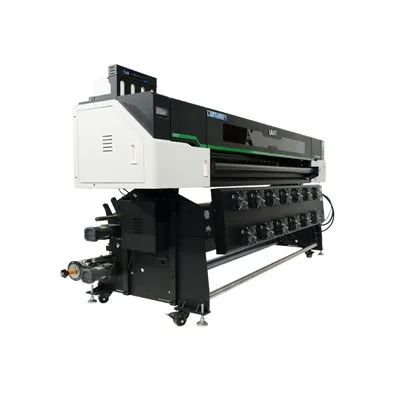
First, let’s clarify what an eco solvent printer even is, because that’s key to understanding its limits. Unlike old solvent printers that used harsh, toxic chemicals, eco solvent printers use milder, low-VOC (volatile organic compound) inks that still deliver the same scratch-resistant, UV-stable, weatherproof results—they just don’t make you feel like you’re standing in a chemical plant while printing. These printers fall into two main categories that directly impact maximum length: roll-to-roll printers and flatbed printers. Most of the questions about maximum length come down to roll-to-roll, because flatbed printers have a hard maximum dimension based on their bed size—usually 5 feet by 10 feet—so their length is fixed. Roll-to-roll, on the other hand, is designed to feed off large rolls of media, which is where the maximum length gets interesting.
So, what’s the official maximum print length for an eco solvent printer? If you check the spec sheet of a mid-range industrial model (the kind we supply to print shops that do 10+ large-format jobs a week), you’ll see a number like 100 meters, 150 meters, or even 200 meters. But that’s the theoretical maximum. The actual maximum length you can use for a high-quality, error-free print is lower—and that’s where a lot of new owners get tripped up. The theoretical number is the absolute longest the machine can feed media without stopping, but in practice, that number drops dramatically once you account for factors like media type, print resolution, and printer calibration.
Let’s break those factors down one by one, because they’re not just technical details—they affect how much money you make on every job. First, media type. The maximum length depends heavily on what you’re printing on. If you’re using a lightweight, flexible vinyl banner (the thin, budget-friendly kind for one-off event displays), most printers can handle up to 100 meters without issues. But if you’re printing on a heavy-duty coated canvas for a wall mural, or a rigid vinyl that’s 10 mils thick, the feed mechanism of the printer has to work harder to pull that thick, stiff media through. Heavy media puts more stress on the pinch rollers, which grip the media, and on the print head carriage, which moves back and forth across the roll. For that kind of media, the safe, reliable maximum length drops to around 50 meters. Push it longer, and you’re at risk of media wrinkling, misalignment, or even the roll slipping mid-print—all of which mean you have to scrap the job and start over.
Next, print resolution. This is a big one that most customers don’t realize matters for length. If you’re printing a simple, low-resolution banner for a construction fence that only needs to be viewed from 10 feet away, you can crank out a 100-meter roll in a few hours, no problem. But if you’re printing a high-resolution photo mural for a hotel lobby, viewed from 2 feet away, you’re printing at 1440 DPI or higher. At that resolution, the printer is laying down millions of tiny ink dots every second, and the print head has to make more passes over the media. The more passes, the more chance there is of a tiny feed error—even a 1-millimeter slip—showing up as a faint line or misalignment in the print. For high-res jobs, the practical maximum length drops to 30 to 40 meters. I once had a customer who tried to print a 80-meter wall mural at 1440 DPI on heavy canvas; halfway through, the media slipped, and he had to throw away $1,200 in materials and reprint the whole thing. That’s the kind of mistake that makes print owners call me to ask for advice, and it all comes down to ignoring how resolution impacts length.
Then there’s printer calibration and hardware quality. Not all eco solvent printers are built the same. The entry-level models that sell for under $10,000 (we don’t supply these, by the way—we focus on mid-range industrial machines for serious print businesses) have basic feed mechanisms that can only handle consistent length for short runs. A high-quality industrial roll-to-roll printer, like the ones we stock, has motorized pinch rollers with pressure sensors, an automatic media tension system, and a linear encoder that tracks the media position 100 times per second. That hardware lets us offer a reliable maximum length of 100 meters for mid-res jobs on standard media. Some of our largest clients—who print long-running banners for major retail chains—regularly do 120-meter jobs without issues, but that’s only on the highest-end industrial models, with pre-calibrated media rolls and print settings tuned specifically for long runs.
Wait, but what about single-piece vs. seamless prints? A lot of customers ask if they can print a 200-meter mural. Technically, yes—you can feed a 200-meter roll through a roll-to-roll printer. But the problem is installing it. Even if you print it perfectly, moving a 200-meter roll of printed media from the printer to the job site, and then hanging it without stretching or wrinkling, is almost impossible. Most professional installers will tell you that any print over 50 to 60 meters for a single wall should be split into two or three pieces with subtle seams—seams that are easy to hide with design. A client of ours who does murals for shopping malls once tried to install a single 110-meter mural; halfway up, the media started to pull, and he had to cut it into four pieces, adding two extra install days and $800 in labor. That’s a cost no one plans for, so even if the printer can handle the length, you have to account for real-world installation limits.
Another factor that’s often overlooked is environmental conditions. Eco solvent printers work best in a temperature-controlled environment, between 60 and 75 degrees Fahrenheit, with low humidity. If your shop is too cold, the media gets stiff, and the feed mechanism struggles. If it’s too hot, the ink dries faster, and the print head can leave streaks on long runs. I’ve had a customer in a remote printing shop in Arizona try to print a 90-meter banner in 95-degree heat; the ink dried so fast halfway through that the head clogged, and he had to replace a $500 print head on top of scrapping the job. If you’re printing in a space without climate control, plan for a maximum length 20 to 30% shorter than the spec sheet says.
Now, let’s talk about what this means for you, as someone looking to buy or use an eco solvent printer. If you’re a small business owner who does occasional small jobs (local banners, trade show displays, 10-foot murals), you don’t need a printer that can do 100 meters. A standard roll-to-roll printer with a 20-meter maximum practical length (for high-res jobs) is more than enough, and it will cost less. If you’re a full-time print shop that does retail chains, event backdrops, or large wall murals, you’ll want a printer with a reliable maximum length of 80 to 100 meters, built with heavy-duty feed systems and precise calibration. And if you ever need a job longer than that, don’t try to push the printer to its absolute limit—plan for seams. A well-placed seam is invisible to the eye, and it saves you hundreds in wasted materials and labor.
I also get asked a lot about whether eco solvent printers are better than other types for long runs. Some customers ask about latex printers, but latex inks are more expensive, and their maximum length is actually similar to mid-range eco solvent printers. UV printers are great for flat jobs, but roll-to-roll UV printers often have shorter maximum lengths than eco solvent models. Eco solvent still leads the pack when it comes to long, flexible runs of media, because the inks bond well to vinyl, canvas, and other materials without needing special curing that can cause feed issues.
Let’s wrap this up with a few hard, practical takeaways that I give every customer:
- The theoretical maximum print length of a standard industrial eco solvent printer is 100 to 150 meters, but the practical, error-free maximum is 30 to 100 meters, depending on media, resolution, and machine quality.
- Always test a long run print on a scrap of the same media you’ll use for your job before committing to a full roll.
- If a job is longer than 60 meters, split it into pieces for easier installation and fewer headaches, even if your printer can handle the full length.
- Invest in a printer with a good tension and feed system— it’s the difference between a 50-meter run that works perfectly and a 100-meter run that gets ruined halfway.
At the end of the day, the maximum print length isn’t just a spec number on a sheet. It’s about what works for your business, your clients, and the real-world jobs you take on. We’ve supplied eco solvent printers to businesses ranging from one-person sign shops to national print chains, and the ones that are most successful aren’t the ones that buy the printer with the longest theoretical length—they’re the ones that match their printer’s capabilities to their actual work.
If you’re looking for an eco solvent printer that’s built to handle consistent, reliable long runs, without the headaches of entry-level models, we can help you find the right machine for your job volume and project needs. We also offer training on calibration, media handling, and best practices for long-format prints, so you can avoid the mistakes I mentioned earlier. Whether you’re printing your first large banner or your 100th wall mural, we’re here to help you get the best results for your business. Don’t hesitate to reach out to us to discuss your specific print length requirements, and we can guide you through the best options for your needs.
DTF Printer References:
- Large-Format Printing Industries Association. (2022). Best Practices for Roll-to-Roll Eco Solvent Printing. LPIA Publications.
- Xer Wide Format. (2023). Eco Solvent Printer Capabilities and Material Compatibility. Xer Technical Support Reports.
- Specialty Media Association. (2021). Media Tension and Feed Mechanism Performance in Long-Format Printing. SMA Research Journal.
- International Sign Association. (2022). Best Practices for Long-Installation Large-Format Prints. ISA Installation Guidelines.
Hangzhou Yulan Technology Co., Ltd.
Hangzhou Yulan Technology Co., Ltd. is one of the most professional eco solvent printer manufacturers and suppliers in China. With abundant experience, we warmly welcome you to wholesale the newest eco solvent printer in stock here from our factory. Good service and quality products are available.
Address: Building, No.128 Rihui Road, Linping District, Hangzhou, China.
E-mail: ulinprint@gmail.com
WebSite: https://www.ulinprinter.com/
